























The Strategic Courage Gap: Why Smart Teams Do Everything Right—Except the One Thing That Actually Matters

I’ve sat in hundreds of strategy meetings where brilliant people do something baffling: they spend months tweaking a fundamentally broken approach instead of building the thing they know would actually work.
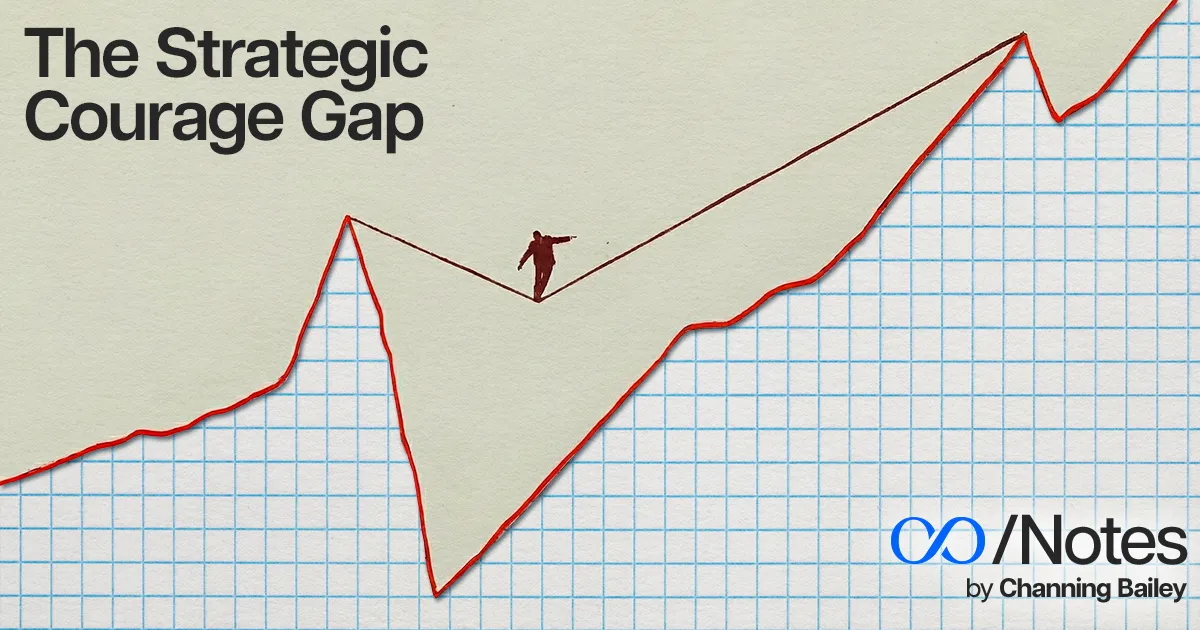
As someone who's led brand and marketing teams, from high-growth startups to household names, and now runs a creative agency, I've learned to recognize this pattern instantly. I call it the Strategic Courage Gap—the space between knowing what needs to be done and having the conviction to actually do it.
And it’s costing you more than you think.
The False Path: Forensic Optimization
Last week, I was listening to The Tim Ferriss Show interview David Baszucki, the founder of Roblox.
He described this trap so clearly that I had to share it.
In Roblox’s early days, revenue was stalling.
They had a subscription model: pay $5 a month, get some perks. A standard playbook.
When growth flattened, the team did what smart teams almost always do:
They went looking for what broke.
They analyzed funnels.
Reviewed recent changes.
Went forensic.
They generated a list of 50 possible optimizations, stack-ranked them, shipped the top 10—and spent six months watching all of them fail.
What Baszucki admitted later is the part that matters:
He knew the real solution the entire time.
Roblox didn’t need better pricing.
It needed an entirely different system.
A digital economy.
Creation would be free.
Users could spend virtual currency anywhere.
Creators could earn real money.
A model that scaled with the platform instead of fighting it.
They avoided it because it was hard.
A full platform overhaul would take months.
It carried real risk.
So instead, they kept “kicking the can down the road,” trying to optimize their way out of a strategic problem.
Sound familiar?
The Pattern I See Everywhere
In my work with ambitious brands—both as an executive and now through Channing & Company—I see this pattern constantly:
Teams optimizing conversion funnels when they need to rebuild their entire positioning.
Companies A/B testing messaging when their core value proposition is fundamentally misaligned with their market.
Creatives tweaking their Instagram strategy when they need to completely reimagine their brand.
The symptoms are always the same:
Endless analysis that produces no clarity
Lists of small improvements that never move the needle
Team energy draining instead of building
A nagging sense that you’re spinning your wheels working on the wrong problem
Why the Strategic Path Feels Dangerous
Here’s what’s insidious about optimization:
Incremental work feels productive—because it is.
Just productive on the wrong layer.
Roblox’s subscription model had a fatal flaw it could never escape:
It monetized limitation
when unlimited creation was the platform’s core promise.
No amount of funnel tuning fixes that.
You need a different model.
Admitting that takes strategic courage:
Accepting that months of work won’t save the current approach
Committing resources to something that might fail
Owning timelines your board doesn’t want to hear
Betting on vision instead of iterating on knowns
The incremental path offers control.
The strategic path feels like stepping off a cliff.
What Strategic Courage Actually Looks Like
As both a brand strategist and an illustrator, I’ve learned something counterintuitive: the hard thing is often easier than the easy thing.
Let me explain.
When I’m working on a commission and something’s not working—the composition feels off, the concept isn’t landing—I can spend hours making small adjustments. Move this element two pixels. Try a different color palette. Tweak the line weight.
Or I can step back and admit: this entire composition is wrong. I need to start over with a different approach.
The second path feels harder. It means throwing away hours of work. It means facing the blank canvas again. But once you commit to it, everything gets easier. The new composition clicks. The work flows. You’re no longer fighting against fundamental problems.
Baszucki describes the exact same experience. The moment his team committed to building the digital economy—after six months of optimization theater—everything changed:
“The second we committed, like, ‘Forget all these fixes, forget all of these little things, we’re going all in at what we think is the big strategic fix to this problem.’ It was very relaxing and fun.”
Relaxing. Fun.
The hard strategic thing felt more relaxing than the supposedly safer incremental path.
Why? Because they finally had alignment. Twenty people rowing in one direction. No hedging, no backup plans, no scattered energy. Just clear conviction.
The System That Scales
Here’s what Roblox’s digital economy unlocked that their subscription model never could:
Before: Revenue was disconnected from usage. People could play for hours while Roblox made nothing.
After: Revenue = K × Hours Played
One number goes up, the other goes up automatically. The system scales. The team can focus on making Roblox better instead of endlessly tinkering with the business model.
This is what great strategy does: it removes the need for constant intervention.
I see this in brand work all the time. When positioning is right, marketing gets easier. When your value proposition genuinely solves a real problem, you stop needing clever copy to convince people. When your business model aligns with your growth metrics, everything compounds.
But getting there requires the courage to replace what’s broken instead of endlessly fixing it.
The Four-Hour Validation
The day Roblox shipped their digital economy, Baszucki was anxious. They’d bet months on this. What if it didn’t work?
Within four hours, they knew.
Of the top 100 creators on Roblox, 22 had already integrated the new currency features. Users were buying. Creators were selling. The economy was alive.
This is what right looks like: the market responds immediately and unmistakably.
When you’re optimizing a broken model, you can measure forever and never get clarity. When you build the right strategic thing, adoption happens fast.
The Framework: Three Questions
I’ve developed a simple diagnostic for teams caught in the optimization trap. Three questions that reveal whether you’re fixing or avoiding:
1. The Conviction Test – Do you have a clear hypothesis about a big strategic move that would work, but keep finding reasons to delay it?
2. The Energy Test – When you imagine finally doing that big thing, does it feel more energizing than your current optimization work?
3. The Timeline Test – Are you spending months trying to “find what broke”?
If you answered yes to any of these, you’re in the Strategic Courage Gap.
The work you’re doing feels productive. The meetings feel important. The A/B tests generate data. But you’re renovating a house that’s built on sand.
What This Means for You
Whether you’re building a company, leading a team, or developing your own creative practice, you probably have one of these right now.
Some fundamental thing that needs rebuilding while you’re busy optimizing.
Maybe it’s your entire business model, like Roblox.
Maybe it’s your positioning in the market.
Maybe it’s your marketing strategy or your branding.
Maybe it’s how you’re pricing your services or packaging your expertise.
You may already have hunch on what it is. It’s that thing you keep mentioning in late-night conversations with yourself. The big scary pivot that could 10x your success but seems too risky to attempt.
Here’s what I’ve learned from both leading teams and creating work that matters: the risk is in the waiting, not in the doing.
Every month you spend optimizing a broken model is a month your competitors could be building the right one. Every quarter you delay the strategic move is another quarter of compounding you’re missing.
Baszucki’s team was small—just 20 people. They had conviction based on first principles (how real economies work). They had leading indicators they could watch (creator adoption, not just revenue).
But courage was still required.
Because strategic moves always involve longer timelines, higher stakes, and the possibility of being completely wrong.
And yet, when it’s right, everything follows.
Get the Strategic Things Right First
Baszucki uses a metaphor I can’t stop thinking about: “If you’re having a mental health crisis, work on your body and your machinery maybe before you work on the talk therapy. Get the strategic things right first.”
Fix the foundation before you decorate the house.
In my illustration work, I see this constantly. An artist will spend hours perfecting rendering technique when their fundamental understanding of composition is weak. They’re optimizing the wrong layer.
In brand strategy, I see teams obsessing over campaign tactics when their positioning is misaligned. They’re decorating a house built on sand.
The strategic layer—the foundation—determines everything that follows. Get that right, and optimization becomes powerful. Get it wrong, and optimization becomes theater.
The Question
So here’s what I want you to sit with:
What’s the big, difficult strategic thing you’ve been avoiding?
Not the optimization. Not the A/B test. Not the incremental improvement.
The fundamental rebuild. The scary pivot. The thing you know would transform your life if had the courage to attempt it.
You already know what it is.
The only question is: how much longer are you going to spend fixing what you should be replacing?
If you’re facing a “strategic courage gap” moment in your business—that big, difficult move you know you need to make—I’d love to hear about it. Reply to this email or connect with me on LinkedIn.
And if this resonated, I’d be grateful if you shared it with someone who’s stuck in optimization theater when they need strategic courage.
Ready to explore your strategic inflection point?
I work with ambitious brands and teams who are ready to make strategic moves instead of safe optimizations. Whether you’re navigating a platform overhaul, repositioning challenge, or fundamental business model shift—I help teams find clarity and build conviction for the hard thing.
Visit Channing & Company to see how we work
Schedule a FREE consultation to discuss your brand or project.
Further Reading:
Tim Ferriss: David Baszucki, Co-Founder of Roblox — The Path to 150M+ Daily Users, Critical Business Decisions, Ketogenic Therapy for Brain Health, Daily Routines, The Roblox Economy, and More (#834)